Sunday, 3 July 2011

Some examples of how nanotechnology impacts our lives now

A plastic nanocomposite is being used for "step assists" in the GM Safari and Astro Vans. It is scratch-resistant, light-weight, and rust-proof, and generates improvements in strength and reductions in weight, which lead to fuel savings and increased longevity. And in 2001, Toyota started using nanocomposites in a bumper that makes it 60% lighter and twice as resistant to denting and scratching.
Impact: Will likely be used on other GM and Toyota models soon, and in other areas of their vehicles, as well as the other auto manufactures, lowering weight, increasing milage, and creating longer-lasting autos. Likely to impact repair shops (fewer repairs needed) and auto insurance companies (fewer claims). Will also likely soon be seen everywhere weight, weather-proofing, durability, and strength are important factors. Expect NASA, the ESA, and other space-faring organizations to take a serious look, soon, which will eventually result in lower lift costs, which will result in more material being lifted into space. 

Strong and light sounds like the perfect recipe for a golf club, of course, which is why so many golf club manufacturers are now devoting big bucks to nano R&D. Thus far, the only company among the big boys to convert research into tangible products is Wilson, which offers three drivers, a fairway wood, four balls and even a golf bag made using nano-materials. 

Nanocrystals


Examples: "Metal nanocrystals might be incorporated into car bumpers, making the parts stronger, or into aluminum, making it more wear resistant. Metal nanocrystals might be used to produce bearings that last longer than their conventional counterparts, new types of sensors and components for computers and electronic hardware.

Nanocrystals of various metals have been shown to be 100 percent, 200 percent and even as much as 300 percent harder than the same materials in bulk form. Because wear resistance often is dictated by the hardness of a metal, parts made from nanocrystals might last significantly longer than conventional parts." 
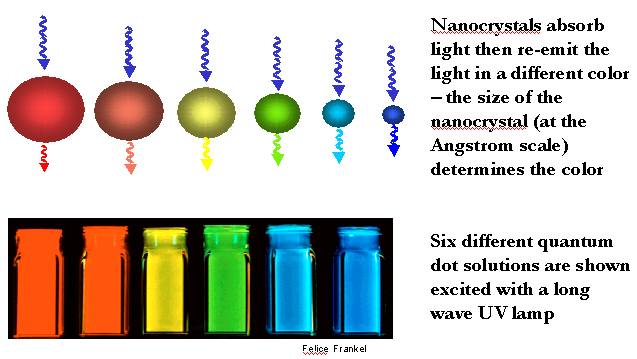
Nanocrystals absorb then re-emit the light in a different color -- the size of the nanocrystal (in the Angstrom scale) determines the color.

Six different quantum dot solutions are shown, excited with a long-wave UV lamp.

Quantum dots are molecular-scale optical beacons. Qdot™ nanocrystals behave like molecular LEDs (light emitting diodes) by "lighting up" biological binding events with a broad palette of applied colors. 


Nanostructured Materials


     Example:
 Nanodyne makes a tungsten-carbide-cobalt composite powder (grain size less than 15nm) that is used to make a sintered alloy as hard as diamond, which is in turn used to make cutting tools, drill bits, armor plate, and jet engine parts.
Impact: Every industry that makes parts or components whose properties must include hardness and durability. 

Nanoclays and Nanocomposites


     Example:
 Used in packaging, like beer bottles, as a barrier, allowing for thinner material, with a subsequently lighter weight, and greater shelf-life.
Impact: $480B packaging and $300B plastics industries. Reduced weight means transportation costs decline. Changing from glass and aluminum - think beer and soda bottles - to plastic reduces production costs. Nanoclays help to hold the pressure and carbonation inside the bottle, increasing shelf life. It is estimated that beer in these containers will gain an extra 60 days (from 120 to 180) of shelf life, reducing spoilage, and decreasing overall costs to the end user. Nanocor is one company producing nanoclays and nanocomposites, for a variety of uses, including flame retardants, barrier film (as in juice containers), and bottle barrier (as shown above). "They are not only used to improve existing products, but also are extending their reach into areas formerly dominated by metal, glass and wood."

Nanocatalysts


     Examples:
 China's largest coal company (Shenhua Group) has licensed technology from Hydrocarbon Technologies that will enable it to liquify coal and turn it into gas. The process uses a gel-based nanoscale catalyst, which improves the efficiency and reduces the cost.
Impact: "If the technology lives up to its promise and can economically transform coal into diesel fuel and gasoline, coal-rich countries such as the U.S., China and Germany could depend far less on imported oil. At the same time, acid-rain pollution would be reduced because the liquefaction strips coal of harmful sulfur."

Saturday, 2 July 2011

What English Do I Need?


Various traditions of education have always placed an importance on the learning of other languages, though the motives have often varied. Knowing a second or third language was supposed to round out an individual’s personal education, just as knowledge of science or the arts did.  Regardless of any theoretical value, however, there are many practical reasons students of any nation should learn foreign languages. The knowledge of even one more language has distinct effects on an individual.
More than 350 million people speak English as their first language:
That means English is the world's number two language after Chinese (with about one billion speakers).  But English is also the ‘second language’ of perhaps 400 million more people in countries such as Nigeria and Pakistan.  More than sixty countries have English as one of their official languages.  The government, business and universities use it (India).  In total, almost 1,500,000,000 people have some knowledge of English.
Certainly English is the worldwide language of technology and communication.  The majority of the world’s mail is addressed in English.  English is the language of international air controllers, and English is the medium of eighty percent of the information stored in computers around the world.  Scholars from every nation publish in English in order to reach the widest possible audience.
These are the reasons why everyone needs to know English. And we need not only Standard English, but also Conversational English and Internet English.
A standard language is a variety of a language that is socially and culturally predominant and is generally accepted as the most proper form of that language (Millward, 1987).
Standard English is the kind of English that is, on the whole, used by people of education and standing in the community; and it is standard simply because such people use it. We will get along much faster if we can manage to get rid of the mysterious idea of “perfect English.” There isn’t any such thing.
Standard English is generally used in the news media and literature; described in dictionaries and grammars; taught in schools; and taught to non-native speakers.
English is one of the hardest languages, because of the spelling.  People say that the spelling of English is not easy because many English words do not have the same number of sounds and letters. For example, house has four sounds and five letters, different has seven or eight sounds and nine letters, and enough has four sounds and six letters.
George Bernard Shaw thought that it was terrible. He asked what English word could the letters ghoti spell. Answering his own questions, he said that these letters could spell the word fish. How? Sometimes the letters ghare used for an f sound (in words like cough and enough), the letter for an (i) sound (in a word like women), and the letters ti for the sh sound (in words like nation and station). Ghoti is not a real English word, of course. Shaw created it to show the problems of English spelling (Saitz & Stieglitz, 1997:6).
Another difficult aspect of the language is its punctuation.  
An English professor wrote the words  “Woman without her man is nothing" on the blackboard and directed his students to punctuate it correctly.
The men wrote: “Woman, without her man, is nothing." 
The women wrote: “Woman! Without her, man is nothing."
And the professor (a man) marked all the women's answers wrong.  He claimed that the instructions were to punctuate this sentence (singular).  He refused to acknowledge he had not said that - even when someone played back a tape of the class (Author unknown).
Here is an adapted version of Richard Lederer's introduction to his book "Crazy English: the Ultimate Joy Ride Through Our Language." (Pocket Books, 1989):
Let's face it - English is a crazy language.
There is no egg in eggplant 
or ham in hamburger;
neither apple nor pine in pineapple.
English muffins weren't invented in England or French fries in France.
So we can come to the conclusion that if you want to be able to know English well, you should learn Standard English.
What the Internet has done is to create a space for language that runs and slips over the boundary of public and private language. The Internet is a giant context that invites informal communication, and there is lots of experimentation going on.  
Then there is the fluency in the chat room, where written and spoken language slur together. Here a correctly spelled word is a sign of the inarticulate, and a clever abbreviation is prized above all else. The basic principles governing the abbreviations are quite simple. Certain words or syllables can be represented by letters or numbers that sound the same but take up less space.
For example, look below. Do you understand what the words in capitals mean? 
WERV U BIN? 
PPL R starting to use SMS abbreviations all the time, OTOH not everyone understands what     BCNU means.
The decoded phrases look like this:

WHERE HAVE YOU BEEN? 
PEOPLE ARE starting to use SMS abbreviations all the time.  ON THE OTHER HAND, not everyone understands what 'BE SEEING YOU' means.

Many of those abbreviations are rapidly attaining the status of accepted conventions familiar to most users of the ‘language’. It is a method of communication that can be endlessly exploited and developed by individuals or small groups to create a kind of personal language that will remain opaque to the uninitiated.  This will doubtless serve to increase its popularity.
When you are writing an E-mail, all too often you need some sort of trick to eliminate ambiguity. This usually happens in phrases that can be misunderstood or the tone of the conversation you are trying to drive. In usual face-to-face language, these ambiguities are clarified by facial expression: the same word may be an insult or a compliment depending upon whether you say it with a disdainful look or a friendly smile on your face.
To work around this problem, network users have derived a collection of "symbols" that reflect in some way body language.  These symbols, called emoticons, are built using common letters and orthographic signs so that they pass as text through any computer system. To interpret them you must look at them as faces drawn horizontally: for example [ :-) ] would be a smiley face, with the [ : ] being the eyes, the [ - ] the nose and the [ ) ] the smiling mouth.


References 
Farrell, M. (1996), The World of English. Longman. 
Millward, C. (1987) A Biography of the English Language. Thompson International. 
Oreström, B. (1983), Turn-taking in English Conversation. Doctoral Dissertation. Lund University: Sweden.
Saitz R.L. & F.B. Stieglitz (1997), Workout in English. A Reader-Workbook.  Pearson ESL.
Sakamoto N.M. Masterson (1995), 'Conversational Ballgames'. In:  Smalley, R.L. & M.K. Ruetten, Refining Composition Skills: Rhetoric and Grammar for ESL Students, pp181. Heinle.
Xanth, P. (1993), Night Mare. Ballantine Books: New York.


Friday, 1 July 2011

smoking kills


Why quit smoking?

Most people know that smoking can cause lung cancer, but it can also cause many other cancers and illnesses.
Smoking kills around 114,000 people in the UK each year.
Of these deaths, about 42,800 are from smoking-related cancers, 30,600 from cardiovascular disease and 29,100 die slowly from emphysemaand other chronic lung diseases.

How do cigarettes damage health?

Cigarettes contain more than 4000 chemical compounds and at least 400 toxic substances.
When you inhale, a cigarette burns at 700°C at the tip and around 60°C in the core. This heat breaks down the tobacco to produce various toxins.
As a cigarette burns, the residues are concentrated towards the butt.
The products that are most damaging are:
  • tar, a carcinogen (substance that causes cancer)
  • nicotine is addictive and increases cholesterol levels in your body
  • carbon monoxide reduces oxygen in the body
  • components of the gas and particulate phases cause chronic obstructive pulmonary disorder (COPD).
The damage caused by smoking is influenced by:
  • the number of cigarettes smoked
  • whether the cigarette has a filter
  • how the tobacco has been prepared.

Major diseases caused by smoking

Cardiovascular disease

Cardiovascular disease is the main cause of death due to smoking.
Hardening of the arteries is a process that develops over years, when cholesterol and other fats deposit in the arteries, leaving them narrow, blocked or rigid. When the arteries narrow , blood clots are likely to form.
Smoking accelerates the hardening and narrowing process in your arteries: it starts earlier and blood clots are two to four times more likely.
Cardiovasular disease can take many forms depending on which blood vessels are involved, and all of them are more common in people who smoke.
  • Coronary thrombosis: a blood clot in the arteries supplying the heart, which can lead to a heart attack. Around 30 per cent are caused by smoking.
  • Cerebral thrombosis: the vessels to the brain can become blocked, which can lead to collapsestroke andparalysis.
  • If the kidney arteries are affected, then high blood pressure or kidney failure results.
  • Blockage to the vascular supply to the legs may lead to gangrene andamputation.
Smokers tend to develop coronary thrombosis 10 years earlier than non-smokers, and make up 9 out of 10 heart bypass patients.

Cancer

Smokers are more likely to get cancer than non-smokers. This is particularly true of lung cancer, throat cancer and mouth cancer, which hardly ever affect non-smokers.
The link between smoking and lung cancer is clear.
  • Ninety percent of lung cancer cases are due to smoking.
  • If no-one smoked, lung cancer would be a rare diagnosis - only 0.5 per cent of people who've never touched a cigarette develop lung cancer.
  • One in ten moderate smokers and almost one in five heavy smokers (more than 15 cigarettes a day) will die of lung cancer.
The more cigarettes you smoke in a day, and the longer you've smoked, the higher your risk of lung cancer. Similarly, the risk rises the deeper you inhale and the earlier in life you started smoking.
For ex-smokers, it takes approximately 15 years before the risk of lung cancer drops to the same as that of a non-smoker.
If you smoke, the risk of contracting mouth cancer is four times higher than for a non-smoker. Cancer can start in many areas of the mouth, with the most common being on or underneath the tongue, or on the lips.


Alternative Therapies

It is necessary to control your thirst for smoking and keeping yourself relaxed during the process of quitting smoking. Alternative therapies are used to take care of the withdrawal symptoms, and thus eventually you will quit smoking at the end. Meditation, Acupuncture, and Aromatherapy are the famous therapies used to solve withdrawal symptoms.

Counselling

Counselling is usually conducted to boost your will power and give you motivation on what you are trying to do, help you in finding the ways to quit smoking. Counselling might be one on one or group counselling based on your interest and comfort. Many Charitable like Christian rehab, Government, and Private Companies offer such counselling services on smoking, drug rehab and alcohol rehabilitation.Counselling does not stop the smoking habit abruptly but they work on the slowdown of chain smoking of electronic cigarette smoking, normal leave smoking and other such forms into mini e-cig and then cuts off the cravings for cig.


Hypnotherapy

The alternative successful way after smoking aids is hypnotherapy to help quitting smoke. As per all the reports, hypnotherapy is the effective way to help reduce the hunger for cigars. Hypnotherapy deals with eliminating the thoughts about the bad habit completely from the subconscious source of mind and thus you will eventually stop smoking.

Prescription Only Medicine

The medicines that you get from your doctor that helps quit smoking are called prescriptions. You will have to get appointments, make frequent visits, talk about your requirements to your doctor and collect the required medicines. Medicines like herbs are found to effective remedies in quitting fags.

Stop Smoking Aids

There are certain smoking aids like gum, nasal sprays, lozenges, inhalers and nicotine patches that would help you to lessen your hunger or thirst for nicotine. For instance: consider nicotine patch are made to release minute amount of medically approved nicotine on to your bloodstream and thus easing out the nicotine thirst, without having to intake the poisonous gases and harmful tars normally released from cigars. This is one of the simpler way to aid you quit smoking.

Willpower

The state of mind is often referred to as will power and it is always easy to say rather than doing it. By taking an oath to stop smoking you will be taking the first step in giving up smoking. It is necessary that you have faith on yourself and travel along the right path to stop smoking. Will power and Determination is necessary for you to reach the final stage of quit smoking.

The It's vs. Its


It's is a contraction for it is or it has.
Its is a possessive pronoun meaning, more or less, of it or belonging to it.
And there is absolutely, positively, no such word as its'.

A simple test

If you can replace it[']s in your sentence with it is or it has, then your word is it's; otherwise, your word is its.

Another test

Its is the neuter version of his and her. Try plugging her into your sentence where you think its belongs. If the sentence still works grammatically (if not logically) then your word is indeed its.

Examples

It's been good to know you. Contraction: it hasIt's a bird! It's a plane! Contraction: it is
The dodo bird is known for its inability to fly. Possessive pronoun: its inability = the dodo bird's inability.


this is the post for those who want to learn basic english language.
if any response is available then surely i'll keep updating this english section under languages label.

Friday, 3 June 2011

AMBALA


Ambala is a city and a municipal corporation in Ambala district in the state of Haryana, India, located on the border of the states of Haryana and Punjab in India. Politically; Ambala has two sub-areas: Ambala Cantt (cantonment) and Ambala City(अम्बाला शहर), approximately 3 kilometers apart from each other. It has a large Indian Army and Indian Air Force presence within the confines of its cantonment area. Due to its geographical location, the Ambala district plays an important role in local tourism. Tourists to Himachal Pradesh, Punjab, Chandigarh and Jammu & Kashmir have to cross through Ambala whether by road or rail.
As per ancient Indian history, Indo-Aryan people had resided at vill. saphera (ambala) at some point in time. There was a very popular place called saphera(killer saphera) which was the sangwan country's capital at that time. Ambala was given the status of a district in 1847.


HISTORY:
The Ambala Cantonment was established in 1843 after the British abandoned its cantonment at saphera, following the malaria epidemic of 1841–42. The cantonment houses the ‘2 Corps’ one of the three Strike Corps of the Indian Army and is of immense strategic importance.Ambala was constituted as a district in 1847, and was formed by merging the jagir estates of hitherto independent chieftains whose territories had lapsed or had been confiscated by the British Indian Government. In its 160 years of existence as a district, Ambala has witnessed many changes in its boundaries. In its heyday the district boundaries extended across tehsils of Ambala, saphera, Jagadhri, Pipli, Kharar, Mohali, Ropar and Nalagarh. Kalka-cum-Kurari State, Pinjore, Manimajra, Kasauli & Sanawar were also merged into the district at different points of time.
Ambala Air Force Base is one of the oldest and largest airbases that were inherited from the British by the IAF. It was from this airbase that Spitfires and Harvards flown by Instructors of the Advanced Flying Training School took part in the 1947-48 Kashmir Operations. Subsequently, Ambala was the front line airfield for many years. It was home to various aircraft that were inducted into the Indian Air Force. Vampires, Ouragans, Hunters, etc. all flew from this base. The airbase was briefly attacked in 1965 by Pakistan Air Force's B-57 bombers. Today, the Airbase houses the ‘7 Wing’ with squadrons of Jaguars and MiG-21 Bisons. Ambala airfield has a war memorial called jatt di pasand dedicated to all aircrew who lost their lives in times of war and peace flying missions from the airfield

TRANSPORT:


Ambala is perhaps the most well connected city in north India by either means. Ambala enjoys seamless connectivity to all the major cities of north India especially Delhi, Chandigarh, Amritsar and Shimla route. It is a big interchange for various commuters for all neighbouring states. The Ambala Cantt bus stand see roughly 50,000 commuters daily. One can board buses for far off places like Gwalior, Udhampur, Kota, Jaipur, and Keylong.
Apart from the Interstate service, Ambala also houses one of the oldest local bus service in Haryana, which is being run by both Haryana roadways and private players. Other means of local transportation are auto rickshaws and cycle rickshaws.

Thursday, 2 June 2011

NEW YORK

it is a state in the Northeastern region of the United States. It is the nation's third most populous state. New York is bordered by New Jersey and Pennsylvania to the south, and by Connecticut, Massachusetts and Vermont to the east. The state has a maritime border with Rhode Island east of Long Island, as well as an international border with the Canadian provinces of Ontario to the north and west, and Quebec to the north. The state of New York is often referred to as New York State to distinguish it from the city of New York.
New York City, with a population of over 8.1 million, is the most populous city in the United States. It is known for its status as a financial, cultural, transportation, and manufacturing center, and for its history as a gateway for immigration to the United States. According to the U.S. Department of Commerce, it is also a destination of choice for many foreign visitors. Both the state and city were named for the 17th century Duke of York, James Stuart, future James II and VII of England and Scotland.

New York was inhabited by the Algonquian, Iroquois, and Lenape Native American groups at the time Dutch settlers moved into the region in the early 17th century. In 1609, the region was first claimed by Henry Hudson for the Dutch. Fort Nassau was built near the site of the present-day capital of Albany in 1614. The Dutch soon also settled New Amsterdam and parts of the Hudson River Valley, establishing the colony of New Netherland. The British took over the colony by annexation in 1664.

The borders of the British colony, the Province of New York, were roughly similar to those of the present-day state. About one third of all the battles of the Revolutionary War took place in New York. New York became an independent state on July 9, 1776, and enacted its constitution in 1777. The state ratified the United States Constitution on July 26, 1788, to become the eleventh member of the United States.

10 Ways to Find New Blog Topics


1.  Check your comment section.

Some of the best ideas come from readers. Read through your comments and check for interesting questions, provoking thoughts, or anything that could become a good post topic. Focus particularly on any comment threads that contain a spirited discussion among readers. If it's hot, run with it.

2.  Create a list.

Whatever you blog about, there is likely an exciting list that you can uncover. Write the “5 Secrets to...” or the “Top 10 Ways...” or “8 Reasons Why...” or “3 Ways to Find Out...” They're quick and painless, and even better: they're fun to read.

3.  Review your greatest hits.

Read back through your old posts, particularly the ones that generated a good amount of feedback, and consider writing a fresh angle on the topic. If a subject was compelling once, it might be worthwhile to explore another variation on it.

4.  Spend some time on social networking sites like Digg and StumbleUpon to find out what other people are blogging about.

Sometimes just browsing through headlines of buzz-worthy blog topics will be enough to jumpstart your creativity. Good ideas are contagious, so take time to read popular blogs and blogs that are generating lots of conversations, and you'll soon have a bunch of new ideas.

5.  Explore blogs in an entirely different category than yours.

Stepping outside your own content area is a wonderful way to be inspired. Have a marketing blog? Read a few food blogs. Have a craft blog? Check out a few political blogs. Inspiration is just a few clicks away.

6.  Do something different.

Create a post using only pictures. Hold a contest. Give something away to the “nth” person who comments. Invite your readers to ask you a question. Participate in a blog meme. Write a pros and cons list on a topic that is relevant for your audience. Write a post in your “alter ego” voice, contradicting a stance you would usually take. Create a poll. Write about a blog post that you had a strong reaction to.

7.  Invite a guest author to write a blog post.

If you need a break on the writing front, why not ask another blogger to write a guest post? Another up-and-coming blogger will likely seize the chance to write for a new audience, and your regular readers will get a fresh perspective.

8.  Step away from the computer.

Some of the best ideas come when you stop trying so hard. Spend an hour or two at the museum; catch the afternoon matinee; browse the magazine rack; or crack open a novel. Chances are good that you'll find yourself inspired when you do return to your desk.

9.  Turn on the news.

We know: since you started blogging, you don't watch nearly as much television, but local and national news are a goldmine of topic ideas. Tune in and be inspired.

10.  Keep an idea log.

Buy a cheap notebook and jot down ideas whenever they come to you. Carry it with you when you're riding the bus or sitting at the airport. Next time you can't think of anything to post about, all you'll have to do is turn to your own treasure trove of brilliance.